Buddha Relics Stolen, Recovered. Implications?
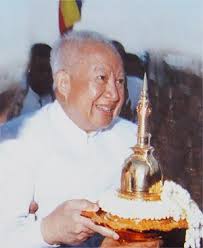
Then-King NORODOM Sihanouk holding the koṭṭha (urn) containing the Buddha’s relics
Back on December 9-10, 2013, in the midst of ongoing conflicts between the CNRP and the CPP over the disputed elections, and separate but connected mass garment worker strikes, physical relics of the Buddha, supposed to contain hair, bone, and ashes of the historical Sakyamuni Buddha, were stolen. Yesterday, February 6, 2014, police claimed to have recovered these relics in Takeo province. Before proceeding to links and discussion, it might be useful to discuss the concept of relics in general. More after the jump:
What’s a Relic?
There are many different types of relics of the Buddha, ranging from the corporeal remains of the Buddha himself, to objects supposed to have been used or touched by him. Like relics in other religions, Buddha relics seem to remain invested with agency of a sort – they frequently are found to have magically multiplied (the old joke about how, if all the pieces of the supposed ‘true cross’ were assembled in one place, they could easily be sufficient to build an enormous naval vessel is simultaneously true, and unproblematic for the faithful, who value relics precisely because they are not natural: of course they can magically multiply. If they were normal, why bother?). Relics also occasionally go missing, or even encourage their own theft by others. Patrick Geary is a scholar of Christian relics, and one of his great books on the topic, Furta Sacra, discusses precisely the tendency of relics to be stolen, and the social implications of such theft. Regarding the relics of the Buddha, I can do no better than to recommend John Strong’s excellent book, The Relics of the Buddha, which I take to be (as is the case with most of his publications), not only excellent, but very nearly encyclopedic (in this case, however, he moves from his tendency toward encyclopedism to a slightly stronger focus on argument, and is in my opinion, even more successful as a result). Here also is a Wikipedia page on Buddha relics. While the link I provide goes directly to the Cambodian Relics subsection, I strongly encourage the reader to scan the rest of the entry, and note the constant relationship between relics and rulership (or sovereignty), part of the complex I identify as deathpower. This connection between political power and the protection of (in both senses) Buddha relics is made abundantly clear in Sri Lankan anthropologist H.L. Seneviratne’s 1978 book Rituals of the Kandyan State
When a relic goes missing, this has historically often been taken as a sign that the rulers of the country have failed somehow, and lost their legitimacy. In the midst of the political and economic struggles of Cambodia at present, some have attempted to make the theft of the relics from the Sakyamuni Cetiya on Phnom Oudong a symbol of the illegitimacy of Prime Minister Hun Sen’s regime.
These particular Buddha-relics were brought from Sri Lanka to Cambodia in 1957 (my local temple here in Minnesota, Watt Munisotaram, is currently building a stūpa to hold Buddha-relics also received from Sri Lanka via the MahāBodhi Society). They were housed in a stūpa built in front of the railway station (near the site of the enormous Canadia Bank Building, I believe), and moved in a fantastic procession from Phnom Penh to Phnom Oudong (also formally called The Sacred and Royal Treasury) in 2002, a procession that included at a minimum tens of thousands (some reports claimed over a million). Here’s a link to the first of a many-parted video document of that procession and the installation of the relics into the newly-constructed Sakyamuni Cetiya on the mountain:
But since 2002, King Sihanouk abdicated the throne to his son King NORODOM Sihamoni, took the title “King-Father,” and then passed away in late 2012, with his final cremation taking place on February 4, 2013, a ceremony I was fortunate to have been able to attend. Politically, the loss of these relics could not have come at a worse time: a new and less confident king on the throne, a long-term and perhaps overconfident Prime Minister being politically challenged more seriously than he had in 15 years, and the largest basis of the export economy struggling with demands, protests, and strikes from workers. (n.b., I plan to write more about the latter soon).
The original report I read on the theft, from the Phnom Penh Post, noted that not only had the Buddha’s relics gone missing, but that the area also contained relics from past Khmer kings. I have heard no additional information on whether these royal relics were actually missing, remain missing, or were recovered. Hopefully more information will be forthcoming soon. I am more sympathetic to garment workers and peasants than royalty, but no one wants their ancestors’ remains to be stolen.
Suspicion immediately fell on the poorly paid guards assigned to the mountain, and to those who frequented the space as fortune tellers or beggars. Despite being charged and held, the five initial suspects were released for lack of evidence, and the persons currently suspected of having stolen the items are not the same people. I was contacted by Colin Meyn of the Cambodia Daily to comment on the issue. I suggested in that article that there were many things the government could be doing a better job at (implying such things as raising the minimum wage, reducing deforestation, corruption, and the incompetent judiciary), though I worry that out of context, the comment might have read as lowering the importance of the event.
I should at this point refer the reader to the impressive collection of links on Sopheak’s blog, posted shortly after the theft.
Buddhist monks, who have become increasingly visible and active in this last year’s oppositional activities (in which I include both political party and garment worker protests), marched through the streets in the hundreds (100-200 estimated), demanding that the relics be recovered, and characterizing the loss of the relics as the result of governmental corruption. These seem to have largely been organized by the Independent Monks Network headed by Ven. But Buntenh. Scholar and politician Son Soubert called the Buddha relics part of the “palladium of the nation,” underscoring the relationship between political sovereignty and the possession of the remains of the Buddha.
The monks’ protest highlighted tensions within the national sangha. As a report published on Religion Dispatches website noted,
Days after the crime, these monks confronted higher-ups in the sangha at a meeting in Phnom Penh, and called for the Supreme Patriarch Tep Vong, who is viewed as an extension of the ruling party, to resign if he failed to recover the urn. A prominent activist monk later called for the Minister of Cults and Religion to step down if he also couldn’t get the job done.
In contemptuous remarks captured by reporters at the confrontation, Vong said it wasn’t his fault, and went on to blame the security guards who were arrested. He said the monks who demanded him to do more didn’t understand a thing. He then called them “crazy people.”
And then, suddenly, the relics were recovered. The news seems to have broken first in the Khmer language press, as is natural, and reports that the police stormed a home in Takeo province, Traing district. Apparently other items stolen were being melted down for sale, and equipment for these purposes was found on the premises. The same article claims (fifth paragraph from the bottom) that Ven. Om. Lim Heng of Watt Chapuh Ka’ek (across the river in suburban Phnom Penh) was called to confirm that all the original relics remained in the urn and are intact.
This, however, will not satisfy everyone. Like Ven. Tep Vong, Ven. Om Lim Heng is seen as an extension of the ruling party, and in fact even closer to Prime Minister Hun Sen than Tep Vong. On page 221 of Ian Harris’ excellent book Cambodian Buddhism: History and Practice, he notes that Om Lim Heng “appears to act as another quasi-official chaplain to Hun Sen”. (A lengthier description of Om Lim Heng and his purported apotropaic and magical powers is included in another essay by Ian Harris on page 174 of Expressions of Cambodia: The Politics of Tradition, Identity, and Change, edited by Leakthina Ollier and Tim Winter). It was at this temple, where Ven. Om Lim Heng is abbot, that Ven. Tep Vong was elevated in 2006 to Supreme National Patriarch of both orders (a tricky sort of position, since the orders are in a small amount of ‘competition’ with each other). I was present at this elevation ceremony, and the amount of security was overwhelming. It was one of the only times in my work in Cambodia when I truly felt that perhaps I should be watching my back more than I was (including my 2005 interview with Nuon Chea at his home in 2005). Indeed, many of the normal lay-attendees warned me to watch out and told me that I was being scrutinized heavily by plainclothes police. I did not see foreign media there, though the crowds were so thick I could have missed it. The following two photos are from that 2006 ceremony, and indicate the connection between Prime Minister Hun Sen, Ven. Patriarch Tep Vong, and the Ven. Om Lim Heng.


Author pictures from the elevation of Ven. Tep Vong to role of Supreme National Buddhist Patriarch, at Temple Champuh Ka’ek (Abbot Ven. Om Lim Heng), attended by Prime Minister Hun Sen and his wife Bun Rany.
As a result, the political opposition and anyone irritated with Hun Sen, have seized on these connections to impugn the reality of the recovery of the Buddhist relics. A facebook page (I loathe facebook, and find the comments on Khmer pages there almost as hateful as on the old KI-Media page) immediately began comment threads suggesting that the relics were fake reconstructions intended to pacify the populace; I confess the same thought occurred to me, but the fact of the matter is that I am far too removed from the events and the relics themselves to have any legitimate opinion.
What is clear, however, is that the loss and recovery of the relics are part of the story of social, religious, and political change ongoing in Cambodia, and since so much of religion is discursive and open to constant contestation and challenge, this story is not finished.
Note: this post updated to correct the location of Traing district from Kampot to Takeo, and to ‘relocate’ the original Buddha relics stupa near the railway station near the new Canadia Bank building).